
The Classical Learning Test or CLT is a college entrance exam designed to assess students’ readiness for higher education through a humanities-centered approach that focuses on interpretation of classic texts and critical reasoning. The CLT has been around since 2015, but has gained more popularity in the past few years. The Florida State University System began accepting the CLT for college admissions in 2023, and other well known schools have followed suit over the past few years. The University of North Carolina System has just announced that it will begin accepting the CLT for the Fall 2027 admissions cycle. Schools in several other states have also announced that they will consider the CLT for admissions.
What is the CLT test?
Like the ACT and SAT, the CLT includes verbal and quantitative components and uses multiple choice questions to score student performance. The CLT focuses more on comprehension of reading richer writing samples from classic texts and on logical reasoning.
What are the differences between the CLT, SAT, and ACT tests?
While all three tests assess reading comprehension, the main differences are in the selection of reading passages that affects the style of the writing and how quickly the student must move through the questions. The CLT emphasizes critical thinking and reading from classical or philosophical texts (Verbal Reasoning), which is a good fit for students strong in reading and humanities. Questions center on interpretation and analysis of the passage, including inference of themes and arguments from the writing.
The verbal section of the SAT (Evidence-Based Reading and Writing) sources readings from literature, social science, and science. Students are asked to find supporting evidence, interpret ideas, understand vocabulary in context, and assess how authors develop their arguments or present data. The ACT assessment of reading comprehension (Reading) is similar to the SAT, but tends toward shorter passages with less nuance for interpretation than the SAT and expects faster student pacing through this section in return.
The three tests differ the most in their quantitative sections. The CLT (Quantitative Reasoning) tests algebra, geometry, trigonometry, logic and does not allow the use of calculators. Of the three tests, it has the highest focus on logical reasoning. This means that questions will focus on concepts like pattern identification and understanding relationships instead of calculation.
The SAT (Math) tests algebra, problem solving, data analysis, some advanced topics like functions and includes sections with and without the use of calculators. The ACT (Math) tests the broadest range of math topics, spanning algebra, geometry, trigonometry, and some pre-calculus and allows the use of calculators on all math sections. Like with the verbal section, ACT questions are more direct but require students to work through each question quickly. Algebra and geometry questions are generally similar across all three tests.
CLT scoring explained
The CLT is scored 0-120 for each section, with a composite score reported that ranges from 0 to 120. This is similar to ACT scoring, where each section is scored 1-36, and a composite score between 1 and 36 is reported. The SAT scores each section from 200-800, and reports the total score of each section added together (400-1600).
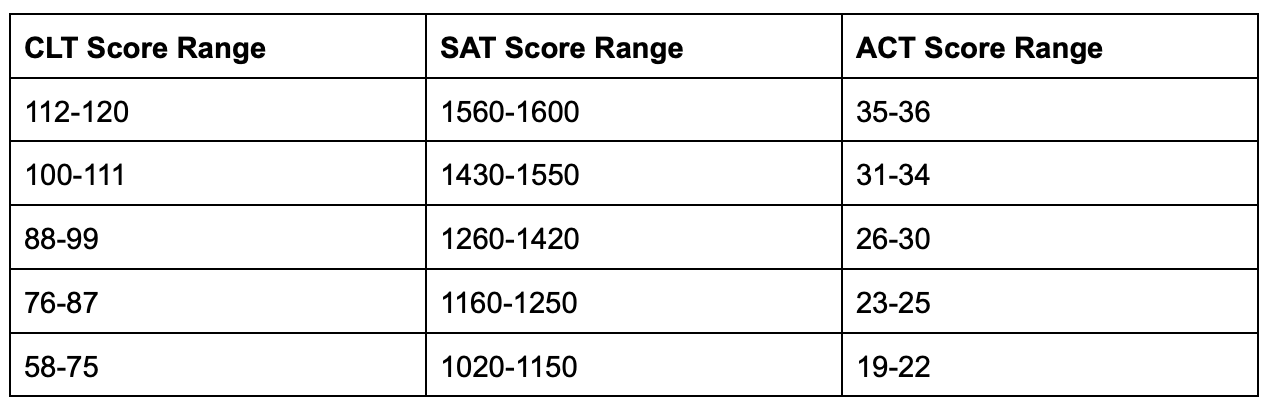
This table shows score approximate equivalencies for the CLT, SAT, and ACT based on data published by the CLT. There has not yet been any independent evaluation of score equivalency.
Should my child take the CLT?
The right test for your child will balance the requirements of their target schools with leveraging their academic strengths. Students with strong reading and reasoning skills and familiarity with reading richer writing styles may showcase those skills on the CLT. Students with a stronger math and science focus and strong analytical reading and data interpretation skills will likely do best with the traditional SAT and ACT tests. At Mindspire, we help identify the best test for students.
Content is not the only difference between these tests. The way questions are asked may also affect the fit of each test for each student. Looking through sample problems or taking a mock test will help them learn which style of questions they are most comfortable with. Mindspire offers mock tests and matches students with the right tutor to excel at their chosen test.
The CLT offers a few logistics advantages. The test is shorter, running two hours instead of three, and can be taken online at home, while other tests are taken at a testing center location even in their online formats. CLT scores are typically returned faster, which allows students to take the test closer to application deadlines.
However, not all colleges and universities accept the CLT. It is most important to consider your student’s goals. Are they applying to programs focused on science, math, or engineering? If so, choosing the SAT or ACT will better highlight their strengths in those areas. We’re here to help you through this process.